
 Mingyu Chen (Rayner)andGabriel
1adeb3a680
### What problem does this PR solve?

Issue Number: None

Related PR: #68631, #68768

Problem Summary:

**In short.** This ports branch-4.1 #68631 (also on branch-4.2) to
master. A Flight SQL `CreatePreparedStatement` now returns the analyzed
result schema of the statement, `GetSchema` is implemented for both
statements and prepared statements, and a prepared execution is checked
against the schema that Prepare advertised. Before this PR, Prepare
always returned a fixed one-column placeholder, and `GetSchema` answered
UNIMPLEMENTED. The analysis runs in the FE only and does not plan or
execute the query.

Original author: @Gabriel39

**Background.** Flight SQL clients learn the shape of a result before
they fetch it. The Arrow Flight SQL JDBC driver prepares every statement
and builds `ResultSetMetaData` from the dataset schema that
`CreatePreparedStatement` returns. ADBC exposes the same schema as
`execute_schema`, and `GetSchema` is the RPC that asks for it without
running anything.

**The problem, and what it cost.** On master:

| | master today | with this PR |
|---|---|---|
| `CreatePreparedStatement` dataset schema | always `ResultMeta: Utf8`,
whatever the statement | the statement's columns, names and Arrow types
as BE / FE will send them; statements whose schema cannot be told before
they run, and results with an untyped NULL column, keep the placeholder
(see below) |
| `GetSchema` for a statement or a prepared statement | UNIMPLEMENTED |
the analyzed schema, or UNIMPLEMENTED for a statement that keeps the
placeholder |
| Invalid SQL | fails only at execution | fails at Prepare with
INVALID_ARGUMENT |
| A query whose privilege check fails | fails only at execution | still
fails only at execution: Prepare keeps the placeholder, because only the
check on the executed plan decides (see below), and GetSchema answers
UNIMPLEMENTED without a schema |
| Prepared handle used after the session's catalog / database changed,
or after the result schema changed (e.g. another session's DDL) | runs
the unqualified SQL in whatever namespace the session has now, with
whatever columns come back | refused with NOT_FOUND "prepare again", and
the result left by that execution is dropped |
| Prepared handle presented by another session | resolved by the
identity written in the handle | must start with the caller's own
identity (from #68768) |
| TIMEV2 / VARBINARY columns in GetTables and Prepare schemas | `Null`,
while BE sends `float64` / `binary` | `Float64` / `Binary`, as BE sends
them |

A client that trusts the advertised schema saw one string column for
every query, and could not ask for a schema at all without executing.

**How this PR fixes it.**

- `arrowflight/FlightSqlQuerySchema` analyzes the statement on a clone
of the session variables: a USE / SWITCH prefix is resolved in a
temporary namespace, the analysis `StatementContext` is closed on the
same thread, and the connector statement scope it may have opened is
closed explicitly. Each field gets the same `doris_type` markers and
native Variant layout the execution side uses
(`FlightSqlSchemaHelper.withDorisTypeMetadata` / `nativeVariantField`),
and TIMESTAMPTZ carries the canonical session time zone that BE stamps
on its batches.
- Privileges are checked on the analyzed plan after the CTEs that
execution inlines have been inlined (`PullUpCteAnchor`, `CTEInline`, as
the rewriter does before its own check). A CTE used once is therefore
checked only on the columns the query reads, and a CTE used more than
once on every column it selects, which is also how execution checks
them. The rewriter normalizes the plan further before it checks
privileges. For example, it drops an ORDER BY under a derived table, so
the analyzed plan can read a column that the executed plan does not.
When the analyzed plan is denied, the statement keeps the placeholder
and execution decides. No schema is disclosed in either case.
- FE-side commands whose result header does not depend on running them
now report that header without running: HELP, SHOW SNAPSHOT, SHOW CREATE
TABLE (one header selector shared with `doRun`, including master's
stream, plugin-view and system-table cases), SHOW PROC `/` and
`/current_queries`, SHOW CONFIG, and EXPLAIN PLAN PROCESS (Rule / Before
/ After).
- `ShowStoragePolicyCommand.getMetaData()` returned the four-column
USING header for every form, while plain SHOW STORAGE POLICY answers the
seven columns of `StoragePolicy.STORAGE_META_DATA`. It now returns the
header of the form that runs. This also corrects the column definitions
that MySQL `COM_STMT_PREPARE` reports for the statement. No other SHOW
command declares a header that differs from the one it returns.
- WARM UP SELECT keeps the placeholder. It answers OK instead of its
statistics whenever planning proves its source empty: a predicate that
folds to false, no partition left after pruning, or partitions without
data.
- A result with an untyped NULL column keeps the placeholder too, at any
depth (`SELECT NULL`, `SELECT id, NULL FROM t`, `ARRAY(NULL)`).
`DorisArrowTypeMapping` gives NULL_TYPE Arrow `Null`, but BE builds such
a column as a `UInt8` flagged as a NULL literal and sends it as nullable
`Bool`, so an advertised `Null` would expire the handle at every
execution. A typed NULL (`CAST(NULL AS VARCHAR(20))`) is described as
its type.
- The prepared query kept in `FlightProtocolAdapter` records the SQL,
the namespace and the advertised schema. A prepared execution
re-analyzes the statement and compares the result with the advertised
schema before it runs, and compares the schema it actually produced
before it publishes a DoGet ticket. It is the session's next request
whether or not these checks pass: before them, it drops what the
previous request left, as a statement's execution does, while Prepare
and GetSchema are metadata requests and leave it. On a mismatch, the
handle is removed, the execution is cancelled, and the deferred
coordinator, the channel result and the endpoints are dropped. A handle
whose statement can no longer be described when it is re-analyzed, for
example after a column grant was revoked, expires the same way, and the
statement prepared again keeps the placeholder. A USE / SWITCH inside
the statement rebinds only that handle.
- `DorisArrowTypeMapping` maps TIMEV2 to `Float64` and VARBINARY to
`Binary`, the types BE sends. TIMESTAMPTZ keeps the fixed `"UTC"` in
GetTables, and AGG_STATE keeps `Null` there.
- `FeServiceClient` rejects a remote Doris metadata timeout whose
milliseconds do not fit in an int, instead of letting it wrap around.

Where master differs from branch-4.x:

- branch-4.x answers UNIMPLEMENTED at Prepare for statements whose
schema it cannot tell before they run: DESC, SHOW DATA / PARTITIONS /
QUERY STATS / PYTHON PACKAGES, other PROC nodes, COPY INTO, WARM UP
CLUSTER, multi-statement requests that do not start with USE / SWITCH,
`?` placeholders, and result types the FE cannot describe. Python ADBC
falls back to executing without a prepared statement, but the Arrow
Flight SQL JDBC driver prepares every statement and has no fallback, so
on master these statements would fail over JDBC.
`test_arrow_flight_session_lifecycle` runs DESC and `SET @multi = 2;
SELECT ...` through JDBC. Here, these statements keep today's
placeholder schema, and their handles are not checked at execution.
- branch-4.x checks privileges on the analyzed plan as it is, so a CTE
used once is checked on every column it selects, and any denial fails
Prepare. Here, CTEs are inlined first, and a remaining denial keeps the
placeholder.
- branch-4.x advertises the statistics header for WARM UP SELECT and
then rejects, as a schema change, an execution whose source turned out
empty. Here, WARM UP SELECT keeps the placeholder.
- branch-4.x advertises Arrow `Null` for an untyped NULL column, which
BE sends as `Bool`, so every prepared execution of such a query is
rejected as a schema change. Here, such a result keeps the placeholder.
- The analysis and the checks run under the session's command lock
(`FlightProtocolAdapter.runCommand` / `callCommand`) instead of
`synchronized (connectContext)`, and the namespace is saved and restored
with `getNameSpaceContext()` / `restoreNameSpaceContext()`.
- EXPLAIN PLAN PROCESS has a result over Flight on master, so it gets a
static header instead of UNIMPLEMENTED. PLAN REPLAYER and SHOW CREATE
PROCEDURE do not exist on master and are not carried over.
- SWITCH resolves the default database through the connector provider
(`Env.defaultDatabaseOnUse`, now shared with `Env.changeCatalog`)
instead of `EsExternalCatalog.DEFAULT_DB`.
- TIMESTAMPTZ fields carry the canonical session time zone that BE
stamps, where branch-4.x uses the raw session value.
- Only the two handle checks from #68768 that do not depend on parameter
binding are taken: the caller-prefix check and rebinding only the handle
that ran the USE / SWITCH. Parameter binding itself is not part of this
PR.
- `GetTableTypes`, the other half of #68631, is implemented by #67899.

Cost: every Prepare, every prepared execution and every `GetSchema` runs
one more FE analysis of the statement.

**Results.** On a local cluster built from this branch, every suite
under `arrow_flight_sql_p0` passes: the new `test_schema_only` and
`test_get_tables_schema`, plus the seven suites that run through Flight
JDBC, `test_arrow_flight_session_lifecycle` among them.
`datatype_p0/uuid/test_uuid_arrow_flight` passes too. `test_schema_only`
checks the advertised schema of each kind of statement against what its
execution actually returns. That covers queries, the side-effect-free
frontend-side commands executed as prepared statements (SHOW STORAGE
POLICY among them), a WARM UP SELECT on an empty table (executed in
cloud mode, the only mode that warms up internal tables), and a
`group_concat_state` AGG_STATE, which BE sends as Utf8.

Co-authored-by: Gabriel <liwenqiang@selectdb.com>
🌍 Read this in other language
English • العربية • বাংলা • Deutsch • Español • فارسی • Français • हिन्दी • Bahasa Indonesia • Italiano • 日本語 • 한국어 • Polski • Português • Română • Русский • Slovenščina • ไทย • Türkçe • Українська • Tiếng Việt • 简体中文 • 繁體中文








Apache Doris is an open-source, real-time analytics and search database built on MPP architecture. It provides fast SQL analytics, lakehouse query acceleration, and hybrid search across structured, text, and vector data.
Explore the official website for the latest product overview, use cases, ecosystem updates, blogs, and user stories. For version updates, see all release notes.
📈 Use Cases
| Use Case | What it provides |
|---|---|
| Customer-Facing Analytics | Ship sub-second interactive analytics to external users. |
| Data Warehousing | Build one real-time warehouse across business domains. |
| Observability | Analyze high-throughput logs, events, and metrics with SQL. |
| Doris for AI | Use vector, text, JSON, and structured search in one SQL engine. |
🚀 Core Capabilities
Apache Doris is built around three core capabilities. The website is the source of truth for detailed product descriptions and examples.
| Capability | What it provides |
|---|---|
| Real-Time Analytics | Streaming ingestion, incremental transformation, and sub-second queries under high concurrency. |
| Lakehouse Analytics | Fast SQL analytics over open table formats such as Iceberg, Delta Lake, and Hudi. |
| Hybrid Search | SQL-native analytics across JSON, full-text, and vector data for AI and search workloads. |
🔌 Ecosystem
Doris sits at the center of the modern data stack. It connects upstream databases, streaming systems, and lakehouse storage with downstream BI, AI, analytics, and observability tools.

For the latest ecosystem coverage, visit the official website and the connection and integration documentation.
👣 Get Started
🧱 Architecture
Apache Doris supports both compute-storage coupled and compute-storage decoupled deployments. In decoupled mode, stateless compute groups run over shared object storage, so you can scale compute on demand and isolate workloads.
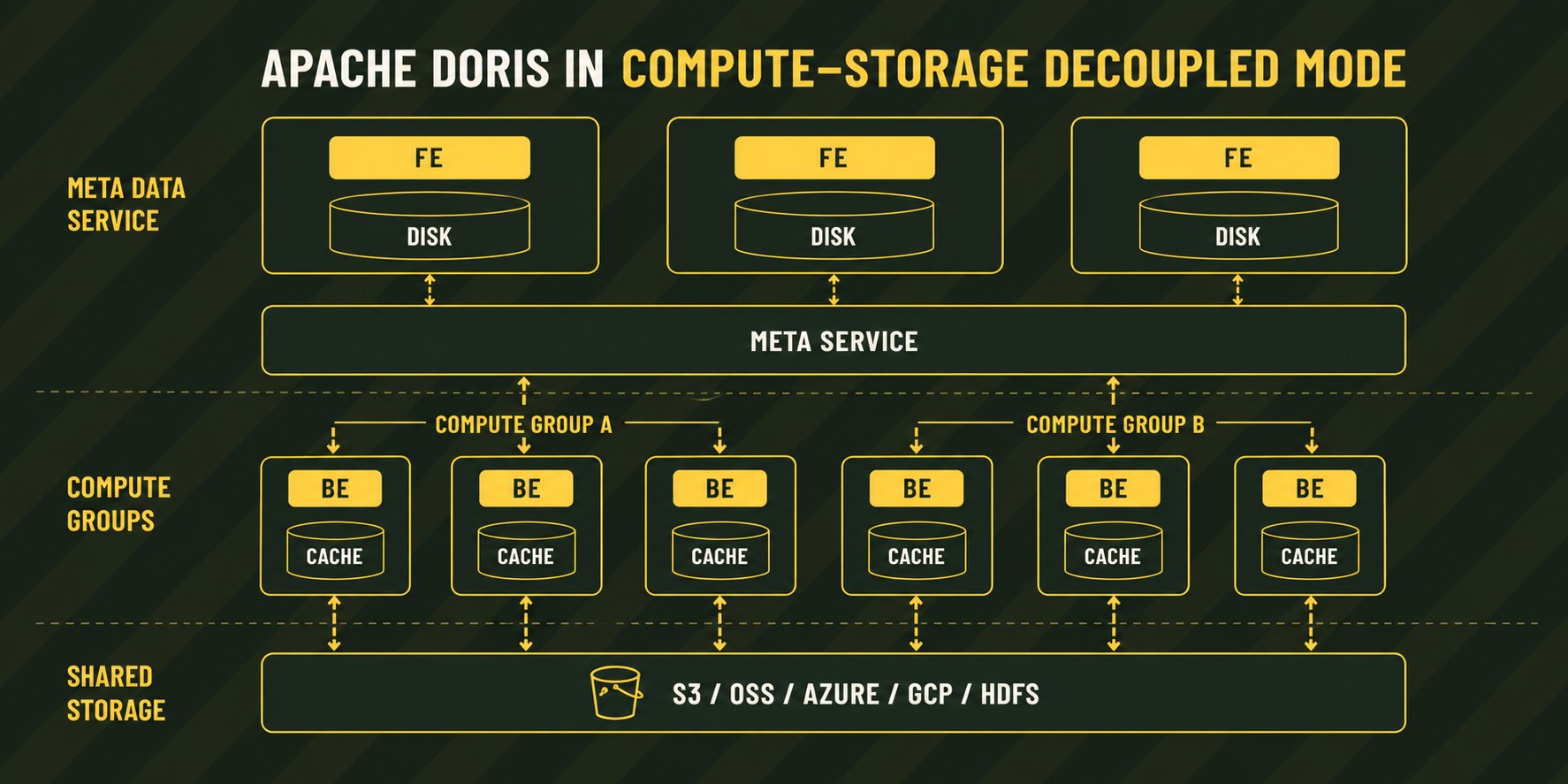
Learn more in the deployment guide and deployment mode guide.
📣 Project Updates
| Resource | What it provides |
|---|---|
| Community Report | Weekly updates on community activity, merged PRs, contributors, and feature progress. |
| Roadmap 2026 | The 2026 planning discussion for AI and hybrid search, query engine, storage, and data lake work. |
🧩 Components
Doris provides connectors and tools for common data engineering workflows.
- Doris Flink Connector
- Doris Spark Connector
- Doris Kafka Connector
- Doris Stream Loader
- Doris Kubernetes Operator
👨👩👧👦 Users
Apache Doris is used in production by thousands of companies worldwide across internet services, finance, retail, logistics, manufacturing, energy, telecommunications, AI, and other industries.
🙌 Contributors
Apache Doris graduated from the Apache Incubator and became an Apache Top-Level Project in June 2022. Thanks to all community contributors who help build Doris.
🌈 Community and Support
💬 Contact Us
🧰 Links
- Apache Doris official website: doris.apache.org
- X: @doris_apache
- Medium: @ApacheDoris
📜 License
Note
Some licenses of the third-party dependencies are not compatible with Apache 2.0 License. So you need to disable some Doris features to comply with Apache 2.0 License. For details, refer to the
thirdparty/LICENSE.txt