 bobhan1
1f5d8bcb35
### What problem does this PR solve?

Issue Number: N/A

Related PR: #3649 (the existing-log resume path)

Problem Summary:

When a BE restarts with `log_split_method=size` and existing
INFO/WARNING logs, Doris's glog patch opens each resumed file with
`open()` and then opens it again with `fopen()`. The first descriptor
has no owner on the success path. Rotation and shutdown close only the
`FILE*`; once the file quota unlinks the old log, the leaked descriptor
keeps its disk blocks allocated until the BE exits.

Use `fdopen(fd, "a")` in both the glog 0.4.0 and 0.6.0 patches so the
stream owns the existing append-only, close-on-exec descriptor.
Initialize the saved file length only after `fdopen()` succeeds, and
close the descriptor on failure before using the existing new-file path.
Skip resume when the file list is empty, including when a quota of one
removes the last existing file.

Add a standalone regression test against the actual static glog library
and run it after the Linux third-party build. It covers INFO and WARNING
logs, append behavior, rotation using the saved file length, repeated
quota deletion, shutdown, empty directories, quota one, and injected
`fdopen()` failure.

### Release note

Fix leaked file descriptors that could retain disk space for deleted BE
logs after restarting with size-based log splitting.

### Check List (For Author)

- Test
    - [ ] Regression test
    - [ ] Unit Test
- [x] Manual test (standalone third-party library regression; details
below)
    - [ ] No need to test or manual test.
- Behavior changed:
    - [ ] No.
- [x] Yes. Resumed log descriptors are released during rotation and
shutdown; an empty resume list and failed `fdopen()` use the normal
new-file path.
- Does this need documentation?
    - [x] No.
    - [ ] Yes.

Validation:

- Applied both updated patches to clean upstream source archives with
`patch --dry-run --fuzz=0`, then rebuilt and installed the static
libraries in isolated directories (0.4.0 using autotools, 0.6.0 using
CMake; optional gflags and libunwind disabled).
- Ran `TP_INSTALL_DIR=<rebuilt-glog-install> CXX=/usr/bin/c++ bash
thirdparty/test/glog-logfile-resume-test.sh` for each version: all four
scenarios passed on each version. Two active log descriptors, zero
descriptors for deleted logs through quota rotations, and zero log
descriptors after shutdown.
- The same test against the existing unmodified Doris glog failed with
`initial write: held=4 expected=2`, confirming that it detects the
original leak.
- `git diff --check`, Bash syntax, ShellCheck 0.8.0, shfmt 3.5.1,
embedded C++ formatting with clang-format 16, and workflow YAML
validation passed.
- A full BE build, BE unit tests, and cluster regression were not run;
validation directly rebuilt and exercised the patched dependency.

### Check List (For Reviewer who merge this PR)

- [ ] Confirm the release note
- [ ] Confirm test cases
- [ ] Confirm document
- [ ] Add branch pick label
🌍 Read this in other language
English • العربية • বাংলা • Deutsch • Español • فارسی • Français • हिन्दी • Bahasa Indonesia • Italiano • 日本語 • 한국어 • Polski • Português • Română • Русский • Slovenščina • ไทย • Türkçe • Українська • Tiếng Việt • 简体中文 • 繁體中文








Apache Doris is an open-source, real-time analytics and search database built on MPP architecture. It provides fast SQL analytics, lakehouse query acceleration, and hybrid search across structured, text, and vector data.
Explore the official website for the latest product overview, use cases, ecosystem updates, blogs, and user stories. For version updates, see all release notes.
📈 Use Cases
| Use Case | What it provides |
|---|---|
| Customer-Facing Analytics | Ship sub-second interactive analytics to external users. |
| Data Warehousing | Build one real-time warehouse across business domains. |
| Observability | Analyze high-throughput logs, events, and metrics with SQL. |
| Doris for AI | Use vector, text, JSON, and structured search in one SQL engine. |
🚀 Core Capabilities
Apache Doris is built around three core capabilities. The website is the source of truth for detailed product descriptions and examples.
| Capability | What it provides |
|---|---|
| Real-Time Analytics | Streaming ingestion, incremental transformation, and sub-second queries under high concurrency. |
| Lakehouse Analytics | Fast SQL analytics over open table formats such as Iceberg, Delta Lake, and Hudi. |
| Hybrid Search | SQL-native analytics across JSON, full-text, and vector data for AI and search workloads. |
🔌 Ecosystem
Doris sits at the center of the modern data stack. It connects upstream databases, streaming systems, and lakehouse storage with downstream BI, AI, analytics, and observability tools.

For the latest ecosystem coverage, visit the official website and the connection and integration documentation.
👣 Get Started
🧱 Architecture
Apache Doris supports both compute-storage coupled and compute-storage decoupled deployments. In decoupled mode, stateless compute groups run over shared object storage, so you can scale compute on demand and isolate workloads.
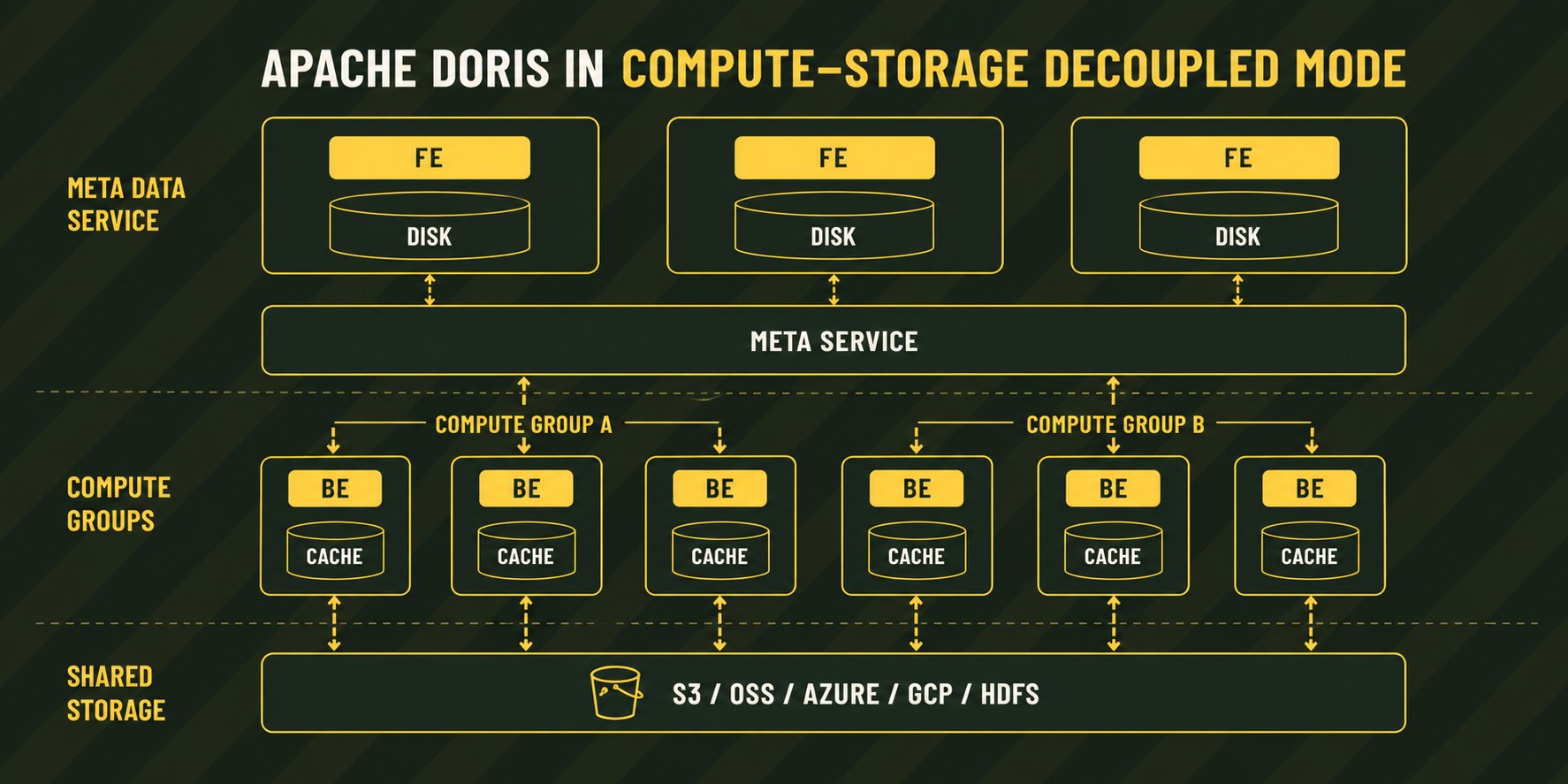
Learn more in the deployment guide and deployment mode guide.
📣 Project Updates
| Resource | What it provides |
|---|---|
| Community Report | Weekly updates on community activity, merged PRs, contributors, and feature progress. |
| Roadmap 2026 | The 2026 planning discussion for AI and hybrid search, query engine, storage, and data lake work. |
🧩 Components
Doris provides connectors and tools for common data engineering workflows.
- Doris Flink Connector
- Doris Spark Connector
- Doris Kafka Connector
- Doris Stream Loader
- Doris Kubernetes Operator
👨👩👧👦 Users
Apache Doris is used in production by thousands of companies worldwide across internet services, finance, retail, logistics, manufacturing, energy, telecommunications, AI, and other industries.
🙌 Contributors
Apache Doris graduated from the Apache Incubator and became an Apache Top-Level Project in June 2022. Thanks to all community contributors who help build Doris.
🌈 Community and Support
💬 Contact Us
🧰 Links
- Apache Doris official website: doris.apache.org
- X: @doris_apache
- Medium: @ApacheDoris
📜 License
Note
Some licenses of the third-party dependencies are not compatible with Apache 2.0 License. So you need to disable some Doris features to comply with Apache 2.0 License. For details, refer to the
thirdparty/LICENSE.txt