 Mingyu Chen (Rayner)
30ce25dc1f
### What problem does this PR solve?

Issue Number: None

Related PR: #68630, #67644

Problem Summary:

#### In short

This ports the BE half of branch-4.x's #68630 to master. When an Arrow
Flight SQL client cancels or closes a result stream before its end,
master keeps the query running: the BE thread serving the stream waits
on the result buffer without ever checking whether the client is still
there, and the unread result blocks stay in memory, holding back the
query, until the query times out or the delayed buffer cleanup runs
minutes later. With this PR the BE notices the cancelled stream within
20 ms, and when the stream is served by the BE that holds its result
(the usual case), that BE cancels the query and frees all of the query's
Flight result buffers there. The FE route that also reaches the query's
other BEs (`cancelFlightQuery`, which changes `FrontendService.thrift`)
comes in a follow-up PR.

#### Background

- A Flight SQL query leaves its result on the BEs. `GetFlightInfo`
returns one endpoint per result buffer, and the client reads each
endpoint with a `DoGet` stream. Since #67504 the FE closes the
coordinator as soon as it has returned the `FlightInfo`, so it no longer
cancels anything on behalf of an open stream.
- `DoGet` is served by `ArrowFlightBatchLocalReader` when the result
buffer is on the same BE, or by `ArrowFlightBatchRemoteReader`, which
pulls the blocks from the result BE with the `fetch_arrow_data` BRPC.
- The result buffer (`ArrowFlightResultBlockBuffer`) is keyed by the
query id when parallel result sink is on (the default) and by the
fragment instance id when it is off. When it is full, the result sink
stops and the query waits for the reader.
- `ResultBufferMgr` drops a buffer that nobody removed at
`execution_timeout + 5 s`, or `result_buffer_cancelled_interval_time`
(300 s by default) after the fragments writing it have finished,
whichever comes first. Finishing with an error does not clear the unread
blocks. `cancel_plan_fragment` is the BRPC the FE uses to cancel a query
on a BE.

#### The problem, and what it cost

- **The local reader never looks at the client.** `get_arrow_batch`
loops on 20 ms waits until a block arrives, the buffer is closed or it
fails. It has no access to `ServerCallContext::is_cancelled()`, so a
`DoGet` cancelled while the buffer is empty keeps a Flight server thread
waiting until the query produces a block or ends.
- **Closing a stream cancels nothing.** The readers do not override
`RecordBatchReader::Close()`, and their destructor only logs. A client
that stops reading (a `LIMIT` reached on the client side, a cancelled
cursor, a dropped connection) leaves the query running and its unread
blocks in the buffer. When the result does not fit in the buffer, the
full buffer back-pressures the result sink and the fragments, with their
memory, wait until the query times out; the unread blocks go only when
the buffer is dropped.
- **The remote reader cannot be interrupted.** It waits for
`fetch_arrow_data` with `brpc::Join`, which returns only when the result
BE answers or `arrow_flight_reader_brpc_controller_timeout_ms` (300 s by
default) passes.
- **An FE cancel leaves the results behind.** `cancel_plan_fragment`
cancels the fragments but not the query's Flight buffers, so their
unread blocks stay until the delayed cleanup 300 s later.
- **A fetch for a removed buffer never completes.** When
`fetch_arrow_data` cannot find the buffer, it logs and returns without
running `done`, so the caller waits for its BRPC timeout instead of
getting an error. #67644 fixes the same line.

#### How this PR fixes it

- **Bounded waits, cancellation checks in the reader.**
`get_arrow_batch(result, eos)` waits at most 20 ms and then returns OK
with no block and `eos = false`; `eos` now marks the real end. The local
reader retries in a loop and checks `is_cancelled()` before each wait.
`DoGetStatement` passes `context.is_cancelled()` to both readers.
- **The reader closes itself.** `ArrowFlightBatchReaderBase` now
implements `ReadNext` (which calls each reader's `ReadNextImpl`) and
`Close()`. A stream counts as aborted when it is cancelled, closed
before EOF, fails while reading, or is destroyed before EOF; a stream
that reached EOF is never treated as aborted.
- **Aborting a local stream cancels the query on this BE.**
`ResultBufferMgr` keeps an index from query id to the query's Flight
buffers, maintained under the buffer-map lock together with the map.
`cancel_arrow_flight_buffers` removes every Flight buffer of the query
from the map, then, outside the lock, fails each buffer (which wakes its
waiting fetches and releases the back-pressure) and cancels the
`QueryContext` it holds a weak reference to. Sibling buffers of the same
query are cleared even after their `QueryContext` has expired.
- **Remote waits can be interrupted.** The remote reader waits for its
BRPC with a callback that checks `is_cancelled()` every 20 ms and calls
`brpc::StartCancel` when the stream is gone.
- **`cancel_plan_fragment` drops the Flight buffers of an aborted
query.** It calls `cancel_arrow_flight_buffers` unless the reason is
`LIMIT_REACH` or `FINISHED`, which can leave valid unread results that
the client still has to read.
- **`fetch_arrow_data` answers when the buffer is gone.** It completes
the RPC with the lookup error. The line is identical to the one #67644
adds, so the two PRs merge in either order.

Differences from branch-4.x: the two consistency checks between the
index and the buffer map are `DORIS_CHECK` (an `if` and a `DCHECK` in
4.x), a null check on the reader's memory tracker that both constructors
make unnecessary is not carried over, and the
`ArrowFlightResultBlockBuffer` constructor moved to the .cpp so that
`varrow_flight_result_writer.h`, which 13 TUs include, does not include
`runtime/query_context.h`; only the .cpp needs its definition. The new
lines also take a few clang-tidy fixes (the destructor calls
`ArrowFlightBatchReaderBase::Close()` explicitly instead of a virtual
call, `std::scoped_lock`), and the test starts its BRPC server inside
`ScopedLeakCheckDisabler`, like the other BE tests that start one,
because brpc registers process-lifetime built-in services on its first
start.

Not in this PR: the FE route. A remote reader's abort, and an abort on
one result BE, still do not reach the query's other BEs; their fragments
and buffers wait for the timeout as before. The follow-up adds
`FrontendService.cancelFlightQuery` (same signature as branch-4.x), the
BE broadcast to the FEs and the FE routing table, together with the FE
unit test and the `test_flight_cancel_cleanup` regression test.

| Situation | Before | After |
|---|---|---|
| Client cancels `DoGet` while the result buffer is empty (local reader)
| Server thread waits until the query produces data or ends | Returns
within 20 ms; the query is cancelled on this BE |
| Client closes a local stream before EOF | Query keeps running,
back-pressured until it times out if the result does not fit; unread
blocks kept for minutes | Query cancelled on this BE; all of its Flight
buffers there freed at once |
| Client cancels while a remote fetch is pending | Waits for the result
BE, up to 300 s | BRPC cancelled within 20 ms |
| FE cancels the query (`cancel_plan_fragment`, abort reason) | Unread
blocks kept until the delayed cleanup, 300 s later | Flight buffers
freed at once; `LIMIT_REACH` / `FINISHED` still keep them |
| `fetch_arrow_data` for a removed buffer | RPC never completes; caller
waits for its timeout | Completes at once with an error |
| Stream read to EOF, then closed | Nothing cancelled | Nothing
cancelled |
| New `DoGet` with the ticket of a stream aborted on its result BE |
Reads the remaining blocks, or EOS | Fails: the buffer is gone |

#### Results

- `ArrowFlightCancelTest` (9 tests, new): early close and destruction
free a back-pressured buffer and cancel the query; sibling buffers are
freed after their `QueryContext` expired; EOF followed by close is not a
cancellation; cancellation interrupts an empty-buffer wait; empty waits
return for retry and do not end the stream; a conversion error cancels
the query; a real Flight server sees a client-side `Cancel()` through
`ServerCallContext` and cleans up.
- `ArrowFlightRemoteCancelTest` (3 tests, new, against an in-process
BRPC `PInternalService`): cancellation interrupts a pending
`fetch_arrow_data`; an aborting `cancel_plan_fragment` frees the buffer
and a following fetch completes with an error inside its 1 s timeout;
`LIMIT_REACH` / `FINISHED` keep the unread results.
- On a local single-BE cluster, branch-4.x's regression
`test_flight_cancel_cleanup` (it aborts one endpoint after the first
batch, by closing it and by an explicit cancel, and requires the query's
pipelines to disappear within 20 s) fails on master with `Cancelled
Flight query retained pipelines: [...: 1 pipeline fragment contexts in
query ...]` and passes with this PR. The suite comes with the follow-up,
because on a multi-BE cluster it also needs the FE route. The 20
`arrow_flight_sql_p0` suites and the 14 `external_table_p0/remote_doris`
suites, which read results over Arrow Flight, pass before and after.
- The 12 new tests plus `ResultBufferMgrTest` (6) and
`ArrowResultBlockBufferTest` (4) pass 10 times in a row in one ASAN
process. Ten single-point mutations of the change (dropping the buffer
cleanup in `cancel_plan_fragment`, the `on_failure` call, the local
cancel in `close()`, the cancellation check in the local read loop or in
the BRPC wait, the sibling loop, the EOF flag, the `QueryContext`
cancel, the cancel in the destructor, the `eos = false` on an empty
wait) each turn their target tests red.
🌍 Read this in other language
English • العربية • বাংলা • Deutsch • Español • فارسی • Français • हिन्दी • Bahasa Indonesia • Italiano • 日本語 • 한국어 • Polski • Português • Română • Русский • Slovenščina • ไทย • Türkçe • Українська • Tiếng Việt • 简体中文 • 繁體中文








Apache Doris is an open-source, real-time analytics and search database built on MPP architecture. It provides fast SQL analytics, lakehouse query acceleration, and hybrid search across structured, text, and vector data.
Explore the official website for the latest product overview, use cases, ecosystem updates, blogs, and user stories. For version updates, see all release notes.
📈 Use Cases
| Use Case | What it provides |
|---|---|
| Customer-Facing Analytics | Ship sub-second interactive analytics to external users. |
| Data Warehousing | Build one real-time warehouse across business domains. |
| Observability | Analyze high-throughput logs, events, and metrics with SQL. |
| Doris for AI | Use vector, text, JSON, and structured search in one SQL engine. |
🚀 Core Capabilities
Apache Doris is built around three core capabilities. The website is the source of truth for detailed product descriptions and examples.
| Capability | What it provides |
|---|---|
| Real-Time Analytics | Streaming ingestion, incremental transformation, and sub-second queries under high concurrency. |
| Lakehouse Analytics | Fast SQL analytics over open table formats such as Iceberg, Delta Lake, and Hudi. |
| Hybrid Search | SQL-native analytics across JSON, full-text, and vector data for AI and search workloads. |
🔌 Ecosystem
Doris sits at the center of the modern data stack. It connects upstream databases, streaming systems, and lakehouse storage with downstream BI, AI, analytics, and observability tools.

For the latest ecosystem coverage, visit the official website and the connection and integration documentation.
👣 Get Started
🧱 Architecture
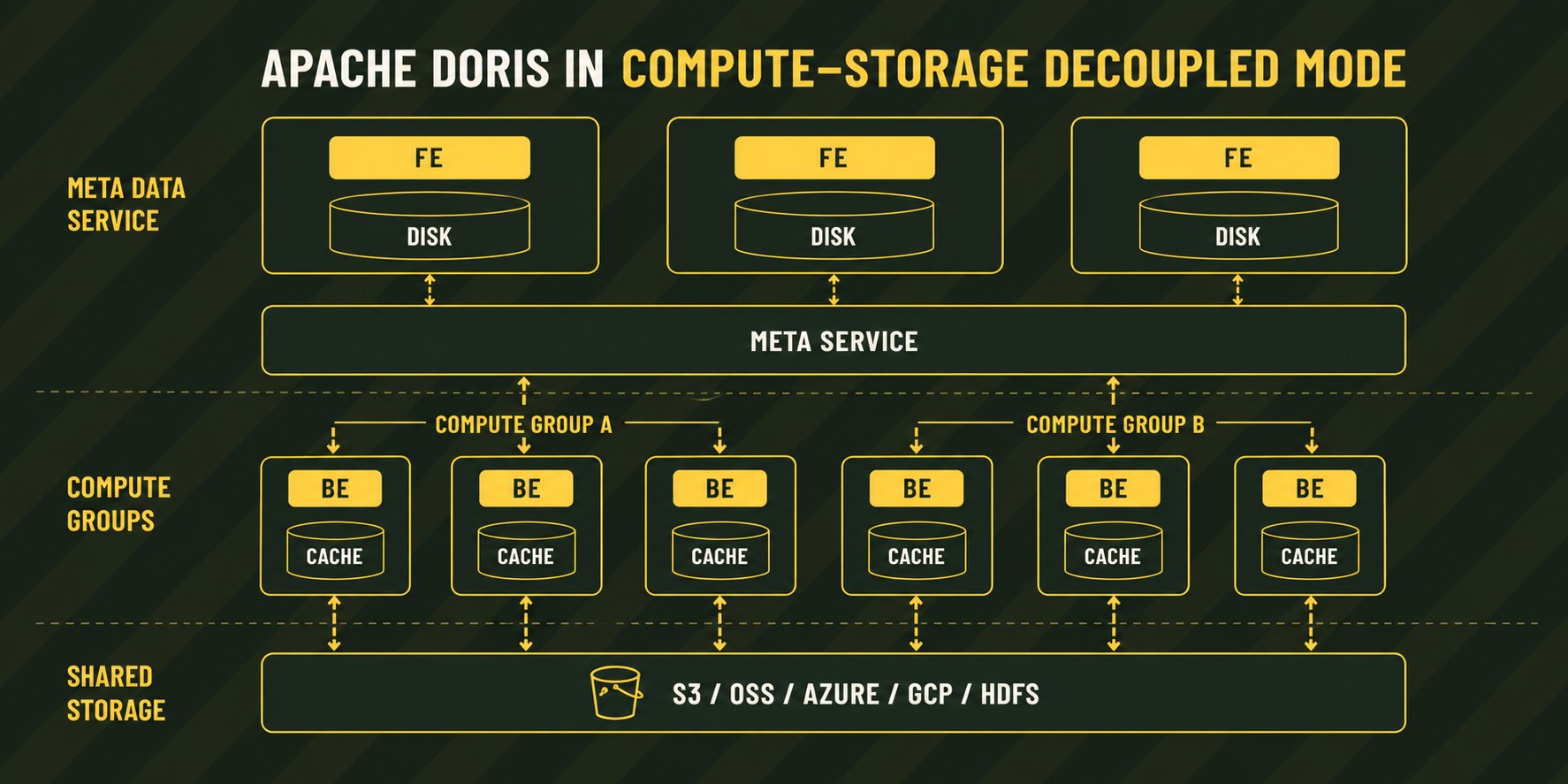
Apache Doris supports both compute-storage coupled and compute-storage decoupled deployments. In decoupled mode, stateless compute groups run over shared object storage, so you can scale compute on demand and isolate workloads.
Learn more in the deployment guide and deployment mode guide.
📣 Project Updates
| Resource | What it provides |
|---|---|
| Community Report | Weekly updates on community activity, merged PRs, contributors, and feature progress. |
| Roadmap 2026 | The 2026 planning discussion for AI and hybrid search, query engine, storage, and data lake work. |
🧩 Components
Doris provides connectors and tools for common data engineering workflows.
- Doris Flink Connector
- Doris Spark Connector
- Doris Kafka Connector
- Doris Stream Loader
- Doris Kubernetes Operator
👨👩👧👦 Users
Apache Doris is used in production by thousands of companies worldwide across internet services, finance, retail, logistics, manufacturing, energy, telecommunications, AI, and other industries.
🙌 Contributors
Apache Doris graduated from the Apache Incubator and became an Apache Top-Level Project in June 2022. Thanks to all community contributors who help build Doris.
🌈 Community and Support
💬 Contact Us
🧰 Links
- Apache Doris official website: doris.apache.org
- X: @doris_apache
- Medium: @ApacheDoris
📜 License
Note
Some licenses of the third-party dependencies are not compatible with Apache 2.0 License. So you need to disable some Doris features to comply with Apache 2.0 License. For details, refer to the
thirdparty/LICENSE.txt