 HappenLee
45d1598da2
AArch64 currently uses portable scalar phmap control-byte scans. The
subtraction-based H2 mask can include adjacent false-positive
candidates: control bytes `0x12, 0x13` can both be returned when looking
for `0x12`. Key comparison preserves correctness, but the extra
candidates cost work.

Add exact NEON control comparisons on little-endian AArch64 while
keeping eight-byte groups, the portable fallback and the existing ARM
dump/load layout. x86 keeps its existing SSE implementation.
`PHMAP_HAVE_ARM_NEON=0` disables the new implementation at compile time.

The normal third-party downloader applies this patch alongside the
existing AArch64 int128 hash-mixer patch, with separate markers and a
subshell that restores the caller's working directory. The NEON patch
now includes context so a replay cannot silently insert the same code
again. The downloader checks the actual source with a direction-locked
reverse dry-run, recovers a missing marker when all hunks are already
applied, and preflights every hunk before a fresh application. Partial
or duplicated sources fail without further edits and do not retain a
success marker. The standalone tests cover control masks, unaligned
reads, special slots, conversion bounds, map operations, rehash and
dump/load. The standalone C++ benchmark can be compiled directly. For an
incremental comparison, retain the existing int128 patch in both the
baseline and optimized dependency sources, adding NEON only to the
optimized copy.

### Supplied ARM measurements

The following measurements come from the supplied report on original
Doris baseline `70f7dcbe11c8e142b81536c1dfaaf505ec05437b`, not a new ARM
run of this rebased PR. That baseline predates master's AArch64 int128
patch. These numbers therefore do **not** establish the incremental
gains of the final combined patch stack; a new ARM run with the combined
patch stack is still needed.

Environment: Neoverse-N2, 16 cores, nominal 3 GHz; Clang 20.1.8; C++17,
`-O3 -DNDEBUG -march=armv8-a+crc -pthread`; one process pinned to CPU
15. Nine alternating baseline/NEON rounds, each measurement at least 0.2
seconds of thread CPU time. Values are median thread CPU ns/op. Reported
intervals use 10,000 paired bootstrap resamples.

Positive time reduction means faster; negative means slower.

| Scenario | Baseline ns/op | NEON ns/op | Time reduction | Reported 95%
interval |
|---|---:|---:|---:|---:|
| Hit lookup, 4,096 keys | 4.0773 | 3.8350 | +5.94% | [+5.84%, +6.11%] |
| Hit lookup, 100,000 keys | 10.6120 | 9.6412 | +9.15% | [+8.99%,
+12.44%] |
| Hit lookup, 114,000 keys | 11.4606 | 10.5508 | +7.94% | [+7.73%,
+11.42%] |
| Hit lookup, 1,000,000 keys | 16.3554 | 14.4228 | +11.82% | [+10.20%,
+12.74%] |
| Miss lookup, 4,096 keys | 3.4818 | 3.3069 | +5.02% | [+4.81%, +5.08%]
|
| Miss lookup, 100,000 keys | 9.7027 | 9.9144 | -2.18% | [-2.91%,
-1.27%] |
| Miss lookup, 114,000 keys | 16.8860 | 17.5147 | -3.72% | [-3.93%,
-2.89%] |
| Miss lookup, 1,000,000 keys | 8.6927 | 8.1035 | +6.78% | [+4.93%,
+9.01%] |
| Insert, 100,000 keys, including allocation/destruction | 9.8116 |
9.2758 | +5.46% | [+3.94%, +6.25%] |
| Erase/reinsert, 20,000 operations per iteration | 16.3032 | 16.3810 |
-0.48% | [-1.19%, +0.97%] |
| Synthetic adjacent-H2 scan, 32,768 groups | 2.7578 | 1.7641 | +36.03%
| [+35.75%, +36.09%] |

Load factors differ: approximately 50.0%, 76.3%, 87.0% and 47.7% at the
four lookup sizes. Two miss-lookup workloads regress reproducibly. The
erase/reinsert interval crosses zero. The adjacent-H2 case measures
group scans and candidate-key comparisons, not complete table lookups.
These are library microbenchmarks, not end-to-end SQL gains.

### Validation

**Reported in the supplied ARM bundle:** randomized scalar-oracle
checks, baseline/NEON/forced-portable paths, bidirectional dump/load and
ASAN/UBSAN passed. The archive contains the patch and report; these ARM
executions were not repeated during this submission.

**Executed locally after rebasing onto master
`3d2d9aac54148056529c13ef4b9fbdbcb65fab77` (x86_64, Clang 16.0.6):**

- Standalone correctness tests passed for baseline, patched and
explicitly NEON-disabled builds; x86 selected the existing 16-byte SSE
groups in all three. Tests also exercise the portable group
implementation directly.
- Baseline-to-patched and patched-to-baseline dump/load passed; patched
ASAN/UBSAN passed.
- Benchmark source compiled with `-Wall -Wextra -Werror`; all 11
scenarios passed a short checksum smoke run. No x86 performance
conclusion is drawn from it.
- Standard third-party download/patch script passed twice with `OLDPWD`
unset. The standard downloader produces byte-identical headers to those
used by the standalone tests.
- clang-format 16, repository clang-tidy entry point for both standalone
C++ files, shell syntax and `git diff --check` passed.

**Downloader recovery follow-up:** `bash
thirdparty/test/parallel-hashmap-patch-test.sh` passed using the pinned
cached archive and the real downloader; no dependency downloads were
needed. It covers fresh extraction, normal reruns, an applied patch with
a missing marker, a stale marker over pristine sources, partially
applied sources with/without a marker, and duplicate NEON definitions.
Successful reruns compare both complete headers; failing cases verify
unchanged source and absence of the success marker. The same test
detects the original replay bug. The regenerated patch inserts exactly
the same 67 C++ lines, and its applied header bytes match the original
optimized source. Bash syntax and shell whitespace checks passed;
generated patch context preserves the pinned dependency's existing
whitespace.

Full Doris BE compilation, SQL regression/performance tests and new ARM
measurements against the combined int128+NEON patch stack have not been
run.

The C++ test and benchmark have no Python dependency and can be compiled
directly:

```bash
bash thirdparty/download-thirdparty.sh parallel_hashmap
clang++ -std=c++17 -O2 -pthread -Wall -Wextra -Werror \
  -isystem thirdparty/src/parallel-hashmap-1.3.8 \
  thirdparty/tests/parallel_hashmap_neon_test.cpp -o /tmp/phmap-neon-test
/tmp/phmap-neon-test
clang++ -std=c++17 -O3 -DNDEBUG -pthread -Wall -Wextra -Werror \
  -isystem thirdparty/src/parallel-hashmap-1.3.8 \
  thirdparty/benchmarks/parallel_hashmap_bench.cpp -o /tmp/phmap-neon-bench
taskset -c 15 /tmp/phmap-neon-bench 0.2
```

Select an available isolated CPU instead of CPU 15 when necessary. For
the reported ARM compiler settings, add `-march=armv8-a+crc`. The
benchmark emits one JSON line per scenario with CPU/wall timings and
checksums. To compare against baseline on current master, extract the
verified source archive into another directory, apply only
`parallel-hashmap-1.3.8-aarch64-int128.patch`, compile the same C++
benchmark against that directory with identical flags, and alternate
baseline/optimized execution order.

### Release note

Accelerate phmap control-byte scanning on little-endian AArch64 while
preserving eight-byte ARM groups and the portable fallback.
🌍 Read this in other language
English • العربية • বাংলা • Deutsch • Español • فارسی • Français • हिन्दी • Bahasa Indonesia • Italiano • 日本語 • 한국어 • Polski • Português • Română • Русский • Slovenščina • ไทย • Türkçe • Українська • Tiếng Việt • 简体中文 • 繁體中文








Apache Doris is an open-source, real-time analytics and search database built on MPP architecture. It provides fast SQL analytics, lakehouse query acceleration, and hybrid search across structured, text, and vector data.
Explore the official website for the latest product overview, use cases, ecosystem updates, blogs, and user stories. For version updates, see all release notes.
📈 Use Cases
| Use Case | What it provides |
|---|---|
| Customer-Facing Analytics | Ship sub-second interactive analytics to external users. |
| Data Warehousing | Build one real-time warehouse across business domains. |
| Observability | Analyze high-throughput logs, events, and metrics with SQL. |
| Doris for AI | Use vector, text, JSON, and structured search in one SQL engine. |
🚀 Core Capabilities
Apache Doris is built around three core capabilities. The website is the source of truth for detailed product descriptions and examples.
| Capability | What it provides |
|---|---|
| Real-Time Analytics | Streaming ingestion, incremental transformation, and sub-second queries under high concurrency. |
| Lakehouse Analytics | Fast SQL analytics over open table formats such as Iceberg, Delta Lake, and Hudi. |
| Hybrid Search | SQL-native analytics across JSON, full-text, and vector data for AI and search workloads. |
🔌 Ecosystem
Doris sits at the center of the modern data stack. It connects upstream databases, streaming systems, and lakehouse storage with downstream BI, AI, analytics, and observability tools.

For the latest ecosystem coverage, visit the official website and the connection and integration documentation.
👣 Get Started
🧱 Architecture
Apache Doris supports both compute-storage coupled and compute-storage decoupled deployments. In decoupled mode, stateless compute groups run over shared object storage, so you can scale compute on demand and isolate workloads.
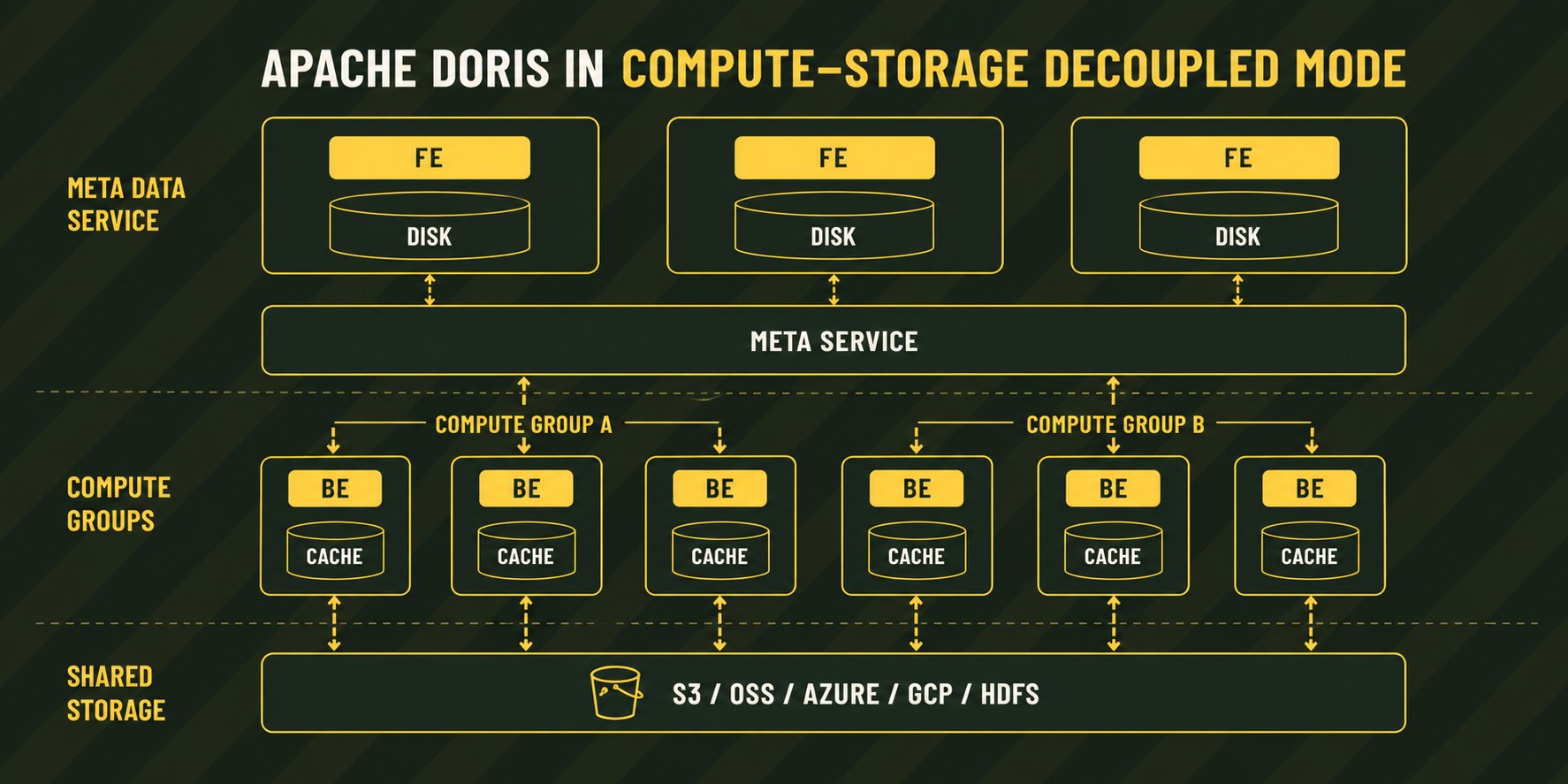
Learn more in the deployment guide and deployment mode guide.
📣 Project Updates
| Resource | What it provides |
|---|---|
| Community Report | Weekly updates on community activity, merged PRs, contributors, and feature progress. |
| Roadmap 2026 | The 2026 planning discussion for AI and hybrid search, query engine, storage, and data lake work. |
🧩 Components
Doris provides connectors and tools for common data engineering workflows.
- Doris Flink Connector
- Doris Spark Connector
- Doris Kafka Connector
- Doris Stream Loader
- Doris Kubernetes Operator
👨👩👧👦 Users
Apache Doris is used in production by thousands of companies worldwide across internet services, finance, retail, logistics, manufacturing, energy, telecommunications, AI, and other industries.
🙌 Contributors
Apache Doris graduated from the Apache Incubator and became an Apache Top-Level Project in June 2022. Thanks to all community contributors who help build Doris.
🌈 Community and Support
💬 Contact Us
🧰 Links
- Apache Doris official website: doris.apache.org
- X: @doris_apache
- Medium: @ApacheDoris
📜 License
Note
Some licenses of the third-party dependencies are not compatible with Apache 2.0 License. So you need to disable some Doris features to comply with Apache 2.0 License. For details, refer to the
thirdparty/LICENSE.txt