 lihangyu
64d2911f64
### What problem does this PR solve?

Problem Summary:

An inverted index on a VARIANT column is copied to every extracted
subcolumn, so a segment holds one
copy of it per path. Since #53980 every analyzed index calls
`setOmitNorms(false)`, and CLucene writes
norms densely: 12 header bytes plus **one byte per segment row for every
indexed field**, including
the rows that hold no value for that field. For a VARIANT column that
cost is multiplied by the
number of paths.

On a real table (~1400 paths, 7 non-BKD indexes per path) a single
base-compacted segment held 9891
`.nrm` files of 4,055,884 bytes each: **37.36 GiB of norms out of a
38.47 GiB `.idx`, 97.1%**.
Segments written before the upgrade had no `.nrm` at all, and the
non-norms bytes had not grown.

Reproduced end to end on 1M rows / 1000 paths / 11 `field_pattern`
indexes, by loading with 3.1 and
then upgrading the same data in place to 4.1:

| | index size after full compaction | `.nrm` |
| --- | --- | --- |
| 3.1 | 99.6 MiB | none |
| 4.1, same data | 934.1 MiB | 875 files x 1,000,012 B = 834.5 MiB |

**9.4x**, and the norms are the whole difference. A/B on the same data:
norms on 457.3 MiB vs norms
off 99.6 MiB (**4.6x**), with identical `MATCH` row counts and sums.

#### What this PR changes

This PR gives operators a way to reclaim that space without changing
what anyone gets by default,
and applies it the same way to the CLucene formats (V2/V3) and to SNII.

1. **A `norms` index property.** An analyzed index writes norms unless
it sets `"norms" = "false"`,
on a VARIANT path exactly as on an ordinary column. A subcolumn copy
inherits the properties of
the index it came from, so the property on a whole-column VARIANT index
also settles every one of
   its subcolumn copies.
2. **A mutable BE config `inverted_index_skip_norms_for_variant`, off by
default.** Turning it on
drops norms for every index on a VARIANT path (an index declared with a
`field_pattern`, or the
copy an extracted subcolumn inherits, which carries the path as its
index suffix), whatever that
index's property says, so a cluster hit by the size regression can
recover the space without
   rewriting its index definitions.
3. **One policy function.** `should_write_index_norms(const
TabletIndex&)` holds the rule, and the
three places that decide whether norms get written all call it: the
CLucene writer, the SNII
writer, and SNII direct compaction. SNII direct compaction rebuilds
norms from the merged postings
rather than copying them; the other SNII compaction path rebuilds the
index through the SNII
   writer.
4. **BM25 scoring needs norms from every segment it reads, in both
formats.** `MATCH` filtering is
unaffected; a query that computes `score()` on an analyzed index fails
with
`INVERTED_INDEX_NOT_SUPPORTED` when any segment of the field has no
norms.
- SNII already worked this way (`resolve_snii_scoring_segment`); its
message now names the
property and the config instead of suggesting that compaction will bring
the norms back.
- CLucene did not. It keeps a field's token count in the `.nrm` header,
and a row without norms
reads the fake norm `encodeNorm(0)`, i.e. length 0. With no segment
carrying norms, `avgdl` was
0 and `score()` came out NaN. With only some segments carrying norms, as
while the config is
being turned on, `avgdl` stayed positive and the rows without norms
ranked as the shortest
possible documents, above otherwise identical rows.
`CollectionStatistics` now refuses such a
segment before any score is computed. An index that is not analyzed
never writes norms and is
collected as before, so `SEARCH` scoring over keyword fields is
unchanged.

#### Compatibility

- Defaults are unchanged: norms are still written everywhere unless
someone opts out, and an index
  that has norms scores exactly as before.
- No storage format change.
- Turning the config on, or setting `"norms" = "false"`, is for indexes
that are never ranked with
`score()`. For such an index, `score()` fails as soon as one segment
without norms exists.
- A table upgraded from a version that did not write norms (before 4.0)
now fails `score()` on its
analyzed indexes until compaction has rewritten the old segments, where
it used to return NaN or
  skewed scores.
- Change the property or the config only after every BE runs this
version.

### Release note

Added the `norms` inverted index property and the BE config
`inverted_index_skip_norms_for_variant`
(off by default, mutable), which drops BM25 norms for inverted indexes
on VARIANT paths and can cut
the index size of a VARIANT column with many indexed paths by several
times. Both apply to the V2,
V3 and SNII index storage formats. A query that computes `score()` on an
analyzed index now fails
when a segment it reads has no norms, instead of returning NaN or
inconsistent scores.

### Check List (For Author)

- Test: Unit Test / Regression test
- `be/test/storage/segment/inverted_index_writer_test.cpp`:
`NormsFollowIndexNormsProperty`
- `be/test/storage/index/snii_writer_test.cpp`:
`SniiWriterNorms.WritesNormsFollowSharedNormsPolicy`
-
`be/test/storage/index/snii/compaction/snii_compaction_eligibility_test.cpp`:
      `DestinationWritesNormsFollowSharedNormsPolicy`
-
`be/test/storage/index/inverted/similarity/collection_statistics_test.cpp`:
`LegacyV3RejectsSegmentWrittenWithoutNorms` (alone and next to a segment
with norms),
`LegacyV3KeywordIndexWithoutNormsIsStillCollected`, and the existing
SNII rejection tests
-
`fe/fe-core/src/test/java/org/apache/doris/analysis/InvertedIndexPropertiesTest.java`
- Regression: `inverted_index_p0/test_variant_subcolumn_index_norms`
(checks the `.nrm` files)
and `inverted_index_p0/storage_format/test_storage_format_snii_norms`
(reads norms off the
scores): `MATCH` still filters, `score()` fails without norms, including
on a mixed-generation
table. Both are nonConcurrent, since they flip the BE config. Also
rerun:
`test_bm25_score_variant`, `test_omit_norms`,
`test_search_score_topn_predicates`,
`test_search_score_cache`, `test_search_score_topn_delete_predicate`,
      `test_storage_format_snii`
- Behavior changed: No for defaults. `score()` on an analyzed index with
a segment that has no norms
  now fails instead of returning NaN or skewed scores.
- Does this need documentation: Yes
(https://github.com/apache/doris-website/pull/4146)
🌍 Read this in other language
English • العربية • বাংলা • Deutsch • Español • فارسی • Français • हिन्दी • Bahasa Indonesia • Italiano • 日本語 • 한국어 • Polski • Português • Română • Русский • Slovenščina • ไทย • Türkçe • Українська • Tiếng Việt • 简体中文 • 繁體中文








Apache Doris is an open-source, real-time analytics and search database built on MPP architecture. It provides fast SQL analytics, lakehouse query acceleration, and hybrid search across structured, text, and vector data.
Explore the official website for the latest product overview, use cases, ecosystem updates, blogs, and user stories. For version updates, see all release notes.
📈 Use Cases
| Use Case | What it provides |
|---|---|
| Customer-Facing Analytics | Ship sub-second interactive analytics to external users. |
| Data Warehousing | Build one real-time warehouse across business domains. |
| Observability | Analyze high-throughput logs, events, and metrics with SQL. |
| Doris for AI | Use vector, text, JSON, and structured search in one SQL engine. |
🚀 Core Capabilities
Apache Doris is built around three core capabilities. The website is the source of truth for detailed product descriptions and examples.
| Capability | What it provides |
|---|---|
| Real-Time Analytics | Streaming ingestion, incremental transformation, and sub-second queries under high concurrency. |
| Lakehouse Analytics | Fast SQL analytics over open table formats such as Iceberg, Delta Lake, and Hudi. |
| Hybrid Search | SQL-native analytics across JSON, full-text, and vector data for AI and search workloads. |
🔌 Ecosystem
Doris sits at the center of the modern data stack. It connects upstream databases, streaming systems, and lakehouse storage with downstream BI, AI, analytics, and observability tools.

For the latest ecosystem coverage, visit the official website and the connection and integration documentation.
👣 Get Started
🧱 Architecture
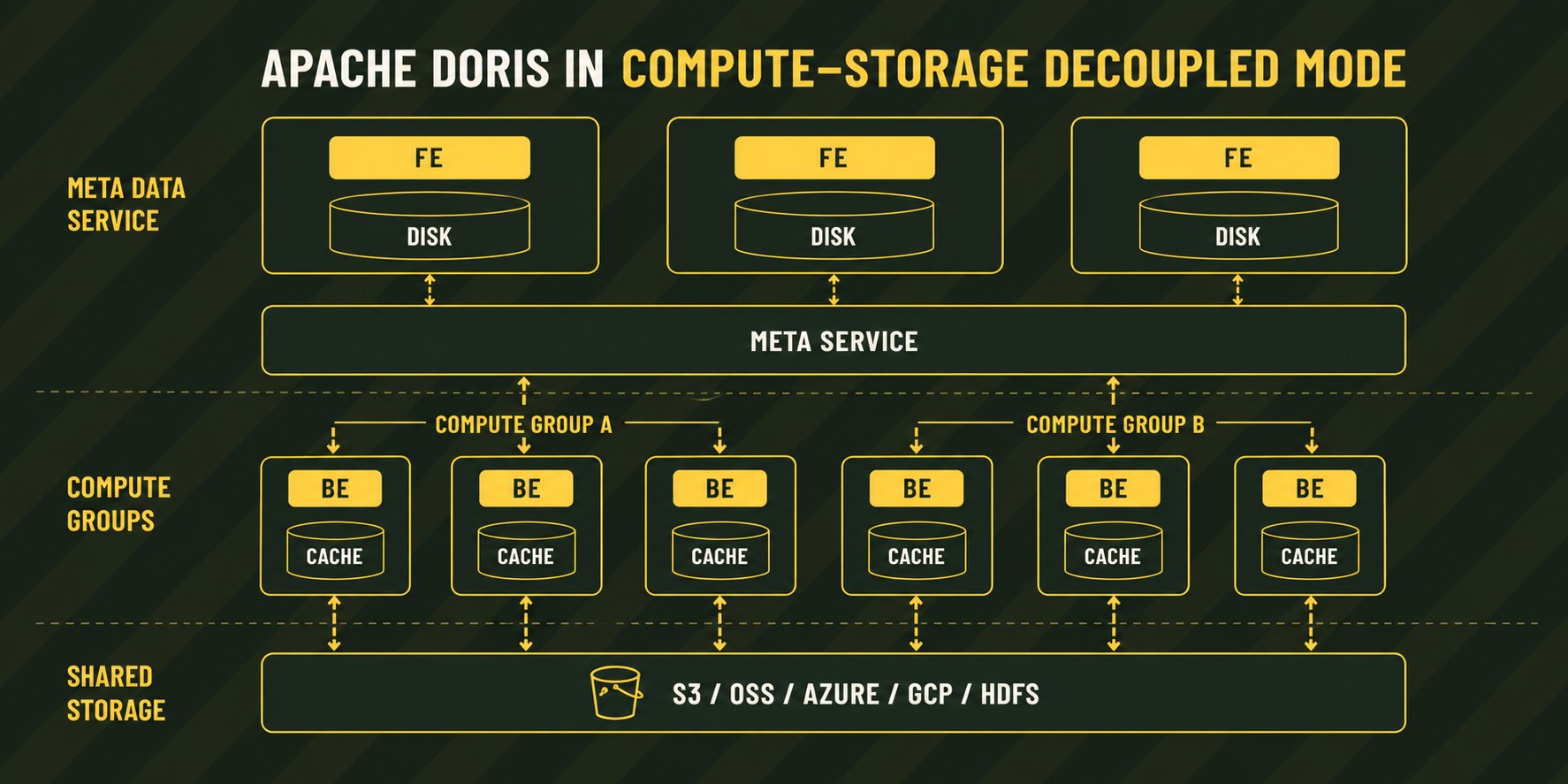
Apache Doris supports both compute-storage coupled and compute-storage decoupled deployments. In decoupled mode, stateless compute groups run over shared object storage, so you can scale compute on demand and isolate workloads.
Learn more in the deployment guide and deployment mode guide.
📣 Project Updates
| Resource | What it provides |
|---|---|
| Community Report | Weekly updates on community activity, merged PRs, contributors, and feature progress. |
| Roadmap 2026 | The 2026 planning discussion for AI and hybrid search, query engine, storage, and data lake work. |
🧩 Components
Doris provides connectors and tools for common data engineering workflows.
- Doris Flink Connector
- Doris Spark Connector
- Doris Kafka Connector
- Doris Stream Loader
- Doris Kubernetes Operator
👨👩👧👦 Users
Apache Doris is used in production by thousands of companies worldwide across internet services, finance, retail, logistics, manufacturing, energy, telecommunications, AI, and other industries.
🙌 Contributors
Apache Doris graduated from the Apache Incubator and became an Apache Top-Level Project in June 2022. Thanks to all community contributors who help build Doris.
🌈 Community and Support
💬 Contact Us
🧰 Links
- Apache Doris official website: doris.apache.org
- X: @doris_apache
- Medium: @ApacheDoris
📜 License
Note
Some licenses of the third-party dependencies are not compatible with Apache 2.0 License. So you need to disable some Doris features to comply with Apache 2.0 License. For details, refer to the
thirdparty/LICENSE.txt