 924060929
b0fd495574
### What problem does this PR solve?

Problem Summary:

FE still carries two execution coordinators: the legacy `Coordinator`
assigns scan ranges and fragment instances itself, while
`NereidsCoordinator` executes Nereids distributed plans but inherits the
legacy coordinator's state and initialization. `CloudCoordinator` adds
another legacy-only factory branch. This duplicates scheduling and
lifecycle ownership and retains a fallback that newer execution features
do not support.

Replace the legacy implementation with the standalone Nereids
implementation, renamed to `Coordinator`, and remove
`NereidsCoordinator` and `CloudCoordinator`. SQL, INSERT and background
load creation now use the same factory. Cloud compute-group selection,
privilege validation and backend membership remain in
`BackendDistributedPlanWorkerManager` during distributed planning.

Preserve the remaining shared capabilities explicitly: HTTP Stream Load
generates parameters with `ThriftPlansBuilder` and retains one fragment
instance on the receiving BE, matching its single completion callback;
Arrow Flight retains scans that must outlive dispatch; streaming INSERT
retains scan backend IDs; cancellation uses the runtime task state,
without treating remote-catalog workers as local backends. Group-commit
backend selection remains in distributed planning.

Keep set-operation bucket-shuffle scheduling markers aligned with the
selected child distribution, including when local shuffle is disabled,
so pruned scans retain all required bucket receivers.

Preserve backend-restart cancellation when a fragment captured an
uninitialized epoch (-1 or 0), while retaining the current-zero
replay/upgrade exception. Stabilize the nested full-outer-join EXPLAIN
with a statement-scoped bucket-shuffle downgrade setting, keeping the
outer-join elimination checks independent of actual backend count and
pipeline parallelism.

Migrate join-distribution assertions to effective statement-scoped
settings: cover both partitioned and bucket-shuffle plans, retain
exchange-count checks, and make pruning checks exercise the bucket path
without an early skip. Keep the removed setting where it still provides
compatibility coverage; do not mechanically rewrite unrelated test
expectations.

Retire `enable_nereids_distribute_planner` using the existing
removed-variable handling and remove its legacy-only optimizer branches.
Migrate unit fixtures to the distributed planner's query identity,
worker and local-exchange contracts. Regenerate EXPLAIN-shape
expectations with the Nereids distribution/property path while
preserving query-result checks.

### Release note

Use Nereids distributed planning for all queries and loads.
`enable_nereids_distribute_planner` no longer selects a planner;
existing SET statements for this removed variable remain accepted.
🌍 Read this in other language
English • العربية • বাংলা • Deutsch • Español • فارسی • Français • हिन्दी • Bahasa Indonesia • Italiano • 日本語 • 한국어 • Polski • Português • Română • Русский • Slovenščina • ไทย • Türkçe • Українська • Tiếng Việt • 简体中文 • 繁體中文








Apache Doris is an open-source, real-time analytics and search database built on MPP architecture. It provides fast SQL analytics, lakehouse query acceleration, and hybrid search across structured, text, and vector data.
Explore the official website for the latest product overview, use cases, ecosystem updates, blogs, and user stories. For version updates, see all release notes.
📈 Use Cases
| Use Case | What it provides |
|---|---|
| Customer-Facing Analytics | Ship sub-second interactive analytics to external users. |
| Data Warehousing | Build one real-time warehouse across business domains. |
| Observability | Analyze high-throughput logs, events, and metrics with SQL. |
| Doris for AI | Use vector, text, JSON, and structured search in one SQL engine. |
🚀 Core Capabilities
Apache Doris is built around three core capabilities. The website is the source of truth for detailed product descriptions and examples.
| Capability | What it provides |
|---|---|
| Real-Time Analytics | Streaming ingestion, incremental transformation, and sub-second queries under high concurrency. |
| Lakehouse Analytics | Fast SQL analytics over open table formats such as Iceberg, Delta Lake, and Hudi. |
| Hybrid Search | SQL-native analytics across JSON, full-text, and vector data for AI and search workloads. |
🔌 Ecosystem
Doris sits at the center of the modern data stack. It connects upstream databases, streaming systems, and lakehouse storage with downstream BI, AI, analytics, and observability tools.

For the latest ecosystem coverage, visit the official website and the connection and integration documentation.
👣 Get Started
🧱 Architecture
Apache Doris supports both compute-storage coupled and compute-storage decoupled deployments. In decoupled mode, stateless compute groups run over shared object storage, so you can scale compute on demand and isolate workloads.
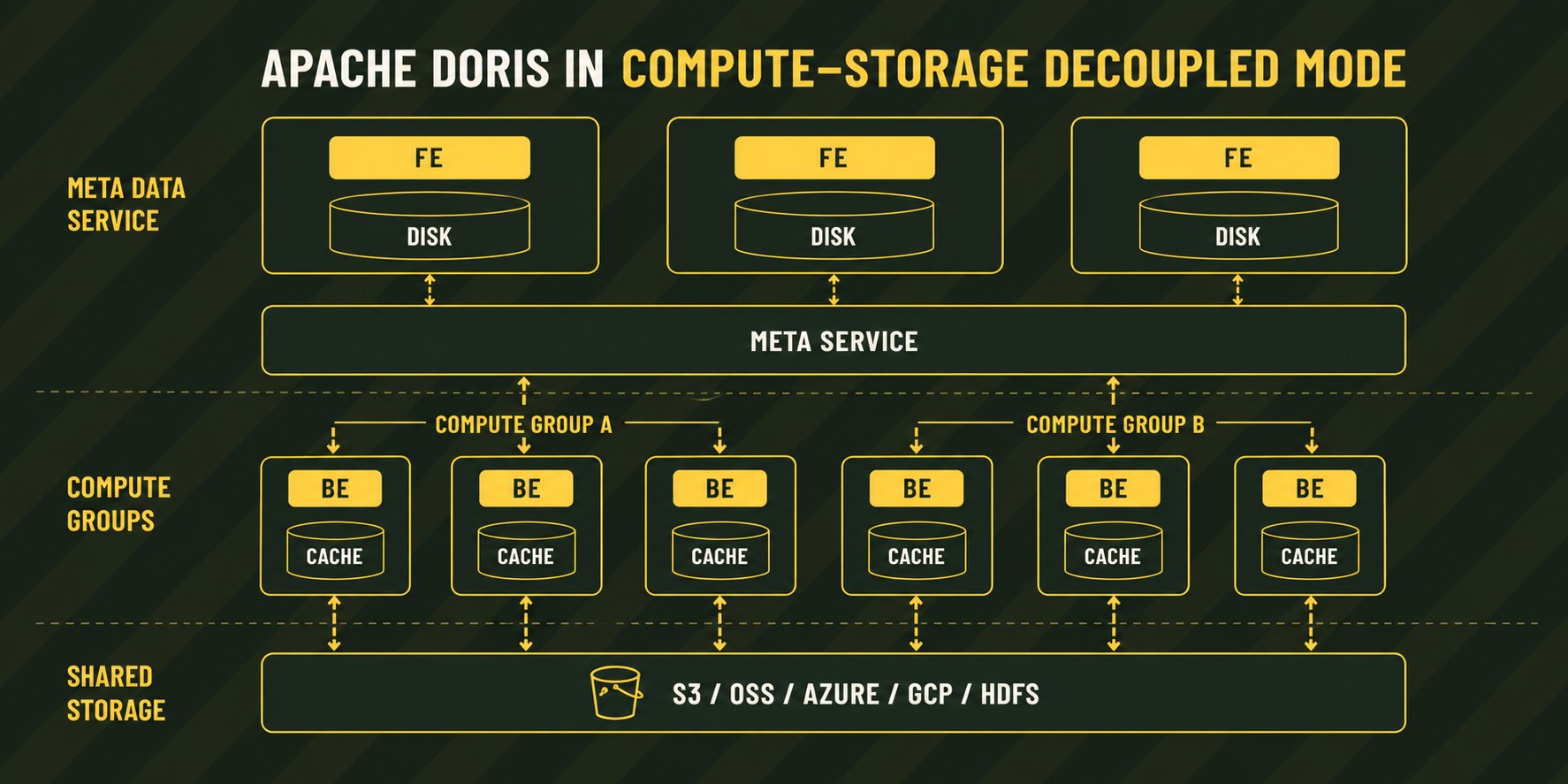
Learn more in the deployment guide and deployment mode guide.
📣 Project Updates
| Resource | What it provides |
|---|---|
| Community Report | Weekly updates on community activity, merged PRs, contributors, and feature progress. |
| Roadmap 2026 | The 2026 planning discussion for AI and hybrid search, query engine, storage, and data lake work. |
🧩 Components
Doris provides connectors and tools for common data engineering workflows.
- Doris Flink Connector
- Doris Spark Connector
- Doris Kafka Connector
- Doris Stream Loader
- Doris Kubernetes Operator
👨👩👧👦 Users
Apache Doris is used in production by thousands of companies worldwide across internet services, finance, retail, logistics, manufacturing, energy, telecommunications, AI, and other industries.
🙌 Contributors
Apache Doris graduated from the Apache Incubator and became an Apache Top-Level Project in June 2022. Thanks to all community contributors who help build Doris.
🌈 Community and Support
💬 Contact Us
🧰 Links
- Apache Doris official website: doris.apache.org
- X: @doris_apache
- Medium: @ApacheDoris
📜 License
Note
Some licenses of the third-party dependencies are not compatible with Apache 2.0 License. So you need to disable some Doris features to comply with Apache 2.0 License. For details, refer to the
thirdparty/LICENSE.txt